In the nineteenth and twentieth centuries, the dissection lab was the site where medical students began their education, a schooling that set them apart from other students because of the knowledge they acquired from gazing into the normally unseen realm of the interior of the human body. As scholar John Bender notes, the anatomy lab initiated “the newly arrived into the professional tribe of physicians.”[1] The class for first year students not only began a socialization process in their trajectory towards the acquisition of professional status, but it also placed them into an arena where the corpse they dissected had no personal autonomy, and while a subject of study, was also a figure of disrepute.[2]
An interesting oddity has been observed with bodies used in anatomical education; medical students in the past, and in some instances even today, often personalized their cadavers, creating a kind of intimacy by naming them or at least a way of coping with the physical discomfort and psychological distress of cutting open a body.[3] For instance, as recently as 2004, students at the University of California in San Francisco were noted as having named their cadavers, mapping personalities onto them.[4] However, this trend extends far back into the past and was a common practice in American medical school education. In the nineteenth and twentieth centuries students often posed with cadavers in photographs that ended up in yearbooks or on postcards.[5] In these photographs the bodies were frequently staged ghoulishly along with the students, taking on new life with the dissectors who often gave the corpses disrespectful nicknames.[6] At times, the bodies, more often skeletons, were shown seated with the students,[7] and at other times, the skeletons were used in visual gags that would invert the austerity expected of an anatomical room, a skeleton portrayed smoking a pipe, for example.[8] One photograph from 1906 comedically features a living student on a table, surrounded by grim collections of cadavers and skeletons mimicking the dissectors.[9] This tradition of what can be called “gallows humor,” moreover, was replicated in medical schools around the country.[10] It reflects a noted phenomenon of dissection which causes students to grow desensitized to cadavers and distances themselves from visualizing the corpses as having been real people.[11] After all, once cadavers were in the hands of medical students, they had lost all agency. Their sovereignty was taken in death, and the students become the sole controllers of their bodies.[12] In this manner, the personalization of cadavers is understood as the total projection of personality from the students onto the bodies, as the bodies had no say in “cadaver antics.”[13]
Emory is not unique regarding the personalization of cadavers; the unofficial mascot of the school was born this way, the skeleton “Dooley.” He made his first known appearance in 1899 in the Emory Phoenix, a student publication of the time.[14] In the 1899 article, Dooley was yet to be named, but admitted to being a skeleton in the biology lab and began ridiculing students for their dim-wittedness and lack of propriety.[15] Dooley reaffirmed this characterization a decade later in 1909 in “Dooley’s Letter,” an article in the same publication where he both announced his name and disclosed his alcoholic past.[16] In this way, Dooley the Skeleton’s presence and existence as a mascot is connected to the meaning behind the personalization of cadavers revealed in the labs at UCSF and in the dissection photographs of the 19th and early 20th centuries. Dooley is projected onto the Emory community as both a skeleton from the biology lab and as a member of the Emory community, one able to comment on student life. However, where Emory and Dooley differentiate themselves from innocuous personalization in medical school photographs in that at Emory, Dooley evolved into a character beyond the classroom and school publications. Indeed, Dooley has a history of walking around campus and sometimes in his early days ended up in the school chapel, a situation that angered then President James Dickey. In the 1909 letter mentioned above, Dooley boasts about the antics that drew Dickey’s rage when he was suspended above Dickey in the chapel.[17] In May 23, 1910, students went further and placed Dooley in a buggy on the roof of the chapel in a garish display.[18] Dooley and his mischievous and disrespectful behavior has continued over the course of Emory’s history, with the skeleton pulling pranks in his early days, before and after the expansion of Emory College into Emory University and the move from the Oxford to the Atlanta campus.[19] Eventually he became as a walking mascot and remains so to this day, even as dissection has become less visible and furtive contemporarily, especially after with the invention of medical imaging techniques and virtual reality dissection tables.[20]
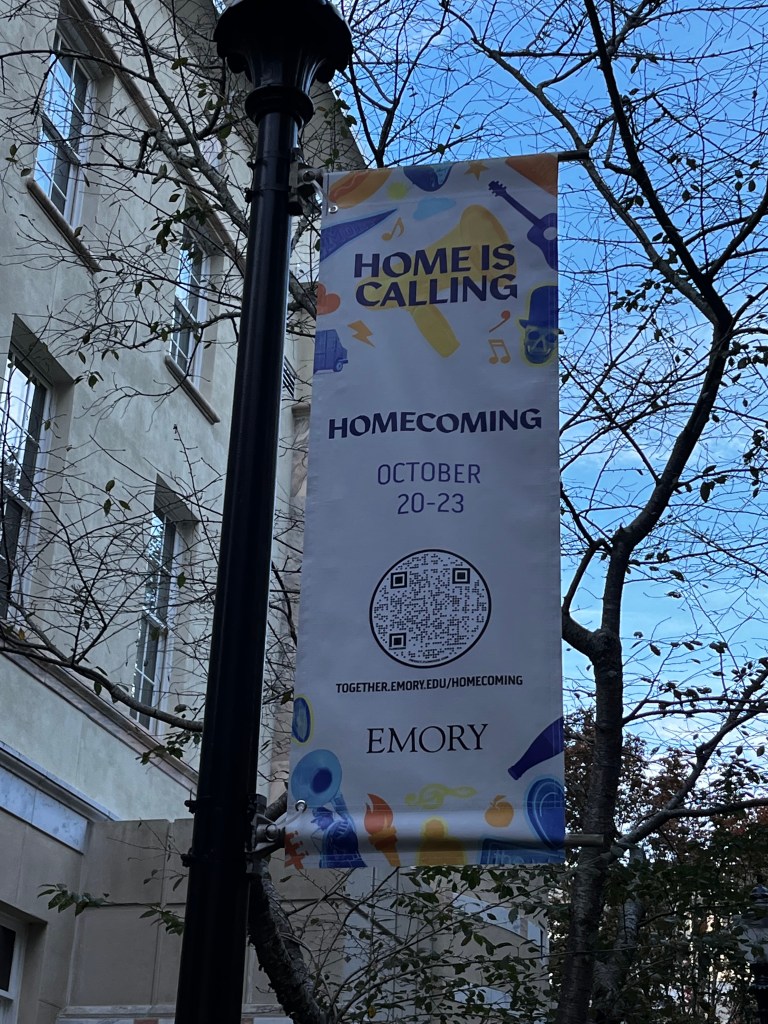
In this way, Dooley the skeleton is a mascot who was born from the traditions of personalizing corpses in medical schools and anatomy labs, a somewhat natural evolution on Emory’s campus connecting the lab to the larger student community. At his inception, he followed the trends concerning the use of skeletons and bodies, portraying himself as one of the students, an image he still carries today when he tours campus during Dooley’s Week and his appearances in official Emory merchandise and branding. However, it is important to remember that the use of bodies and anatomical material in this way was facilitated by the desensitization toward human remains that occurred among medical students in dissection labs, and that in the racialized history of dissection, this desensitization was increased through the use of primarily black bodies.
[1] John Bender, “From Theatre to Laboratory,” Medical Student JAMA: Journal of the American Medical Association 287, no. 9 (March, 2022), 1179.
[2] Bender, “From Theatre to Laboratory,” 1179.
[3] Austin D. Williams Emily E. Greenwald, Rhonda L. Soricelli, and Dennis M. DePace, “Medical Students’ Reaction to the Anatomic Dissection and the Phenomenon of Cadaver Naming,” Anatomical Sciences Education 7 (May/June 2014), 170.
[4] Mary Roach, Stiff: The Curious Life of Human Cadavers (New York: W.W. Norton & Company, 2003), 39.
[5] John Harley Warner, and James E. Edmonson, Dissection: Photographs of a Rite of Passage in American Medicine: 1880-1930 (New York: Blast Books, 2009), 111, 165.
[6] Warner and Edmonson, Dissection, 129.
[7] Warner and Edmonson, Dissection, 131-39, especially 140-41.
[8] Warner and Edmonson, Dissection, 143.
[9] Warner and Edmonson, Dissection, 158-159.
[10] Williams and Greenwald, et. al., “Medical Students,” 170.
[11] Daina Ramey Berry, The Price for Their Pound of Flesh: The Value of the Enslaved, from Womb to Grave in the Building of a Nation (Boston: Beacon Press, 2017), 313.
[12] Berry, 315-316.
[13] Williams and Greenwald, et. al., “Medical Students,” 170.
[14] “Reflections of the Skeleton,” Emory Phoenix, October 1899, email communication with John Bence, March 1, 2021.
[15] “Reflections of the Skeleton.”
[16] “Dooley’s Letter,” Emory Phoenix, October 1909, email communication with John Bence, March 1st, 2021.
[17] “Dooley’s Letter.”
[18] “Buggy and Skeleton Sit on Emory Chapel, Faculty is Startled to Find Queer Discovery on Roof of Building,” The Atlanta Semi-Weekly Journal, May 24, 1910, Image 1,Georgia Historical Newspapers, Galileo, Digital Library of Georgia, (accessed May-August, 2022), https://gahistoricnewspapers.galileo.usg.edu/lccn/sn86090947/1910-05-24/ed-1/seq-1/#date1=01%2F01%2F1845&city=Atlanta&date2=12%2F31%2F1915&words=Dooley+skeleton+SKELETON&searchType=advanced&nottext=&index=10&sequence=0&proxdistance=5&rows=12&ortext=skeleton&proxtext=&andtext=dooley&page=1 .
[19] Henry West, “Dooley Keeps Key to ‘Spirit’,” Emory Wheel, May 7, 1953, 2.
[20] “Dooley’s Week, 2022: The Student Programming Council Invites You to Tune into Dooley’s Jukebox,” Emory News Center, Emory University, (accessed August 20, 2022), https://news.emory.edu/stories/2022/03/er_dooleys_week_23-03-2022/story.html; S. Ryan Gregory, “The Changing Role of Dissection in Medical Education,” Medical Student JAMA: Journal of the American Medical Association 287, no. 9 (March, 2022), 1181.
 Skeletons in the Closet