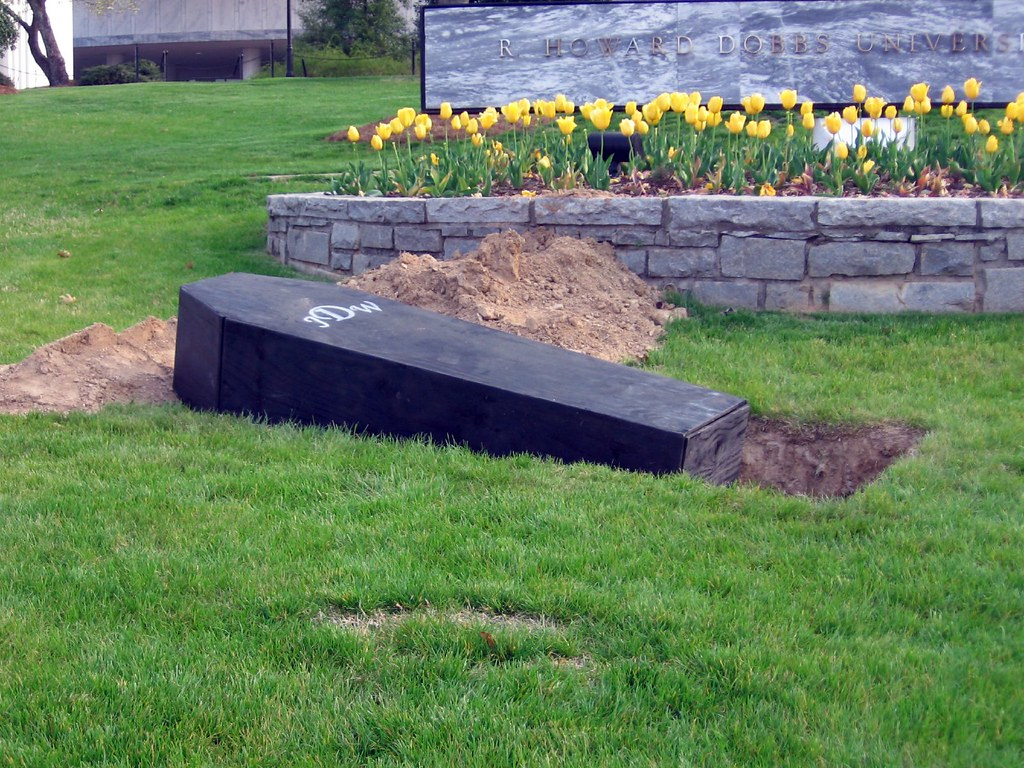
Scholars have argued that members of the white majority in the United States perceive marginalized bodies of color in a manner forever tied to stereotypes of black Americans which formed in the antebellum period and were reinforced after Reconstruction. White perception is racialized, and blacks are stereotyped as simple and inferior.[1] This idea is unfortunately viewable through the lens of Dooley.
To begin, Dooley has always existed at Emory College and University as a divisive figure who inverts the expectations and power structures of the school. Referencing the pranks students pulled, like placing Dooley in the school’s chapel, the skeleton figure is made to show a lack of respect for the institutions of Christianity and Emory’s tie to Methodism that the heads of the college believed guided the college, its actions, and the faculty.[2] Suspending the skeleton above President Dickey’s head in the chapel shows Dooley’s disrespect for the school’s hierarchy. Beyond Dooley’s corporeal presence, his role in inversion is a persistent theme. In Dooley’s first letters for instance, he gossips about students and their behaviors and discounts the rules on decorum and conduct faculty and students traditionally believed were expected of “Christian gentlemen.”[3] Dooley would later go on to continue with his proclivity to speak ill of others and establish his own diary in the 1910 year book in which he formalized a gossip column where he insulted students, faculty, and staff, and furthered his inversion of the expected propriety of Emory students.[4] This publication continued to run in this manner until President James Laney was inaugurated, and Dooley’s power over campus was curbed in the latter half of the 20th century.[5] In terms of academics, moreover, Dooley showed an aversion to ascribing importance to them, at times for instance, even using broken English to communicate.[6] Through all these avenues, Dooley, the unofficial mascot of Emory, earned his title, “The Lord of Misrule,” and cemented his place as a figure of inversion.
Before it is possible to analyze the ways that Dooley and his use of inversion are reflective of a differential view of marginalized people, it is important to understand the zeitgeist of the school pertaining to racism. Emory in its early days as both a college and university was rife with notions of racism. For instance, Alexander Means, founding member of Emory University and former president extolled the superiority of southern culture and the glory of the white race just as he decried the evils of abolitionism. His ideals are revealed in his article, “Thought for the Times No.1” for the December 5, 1861, edition of the Southern Christian Advocate.[7] Further, racism was even present in the student curriculum. For example, the 1872-1873 school catalog notes that the physiology course being offered in the spring term of the third year required a textbook called “Drapers.”[8] This textbook is likely John Draper’s, A Textbook on Anatomy, Physiology, and Hygiene for the Use of Schools and Families. Draper’s book provides a clear example of racism subsumed within formal school curriculum. On page 229 of the text, black people are compared to apes, and it is argued that this similarity is a genetic certainty of white supremacy.[9] Later still, after the expansion of Emory into a university, Hal Davison, while working in the segregated wing of a hospital provided to Atlanta by Emory, opportunistically studied the bodies of black Americans suffering from heart disease and published his findings in Cardiac Disease in the Negro: A Preliminary Report.[10] The report itself uses differential and racist language throughout the entirety of the work and concludes that the health problems facing the black community are a financial burden to the state.[11] While it is only fair to state that Dr. Davison also points out possible reasons for this issue stemming from inequitable treatment, the language used to discuss black Americans and their health being viewed as financial burdens are examples of racism in that they detach blacks from their humanity, attaching them instead to a dehumanized dollar amount, reinforcing their slave past.[12] Thus the culture surrounding students before and during the time of Dooley’s creation was filled with negative and racist sentiments concerning people of color. Dr. Means was a professor of science at Emory,[13] Draper’s text was part of the curriculum, and Dr. Davison himself was a professor at Emory in the early to mid-1900s.[14] Effectively, racist sentiments were inescapable at Emory and surrounded students whether disseminated in their textbooks or in the beliefs held by their teachers. This is all compounded with the period Dooley began in, the turn of the 20th century, a period rife with sentiments encircling the lost cause and targeted aggression toward Americans of color following Reconstruction. These were sentiments that the children of Emory College, children of the confederacy undoubtedly were aware of and used to create the character of the skeleton. Racist sentiment undoubtedly influenced Dooley’s creation and function as a mascot and campus figure.
Understanding the ubiquity of racism in Emory’s past is crucial to understanding the creation of Dooley. In the February 21, 1924 article, “Look Out “Dooley,” in the student publication, the Emory Wheel, it is said that it is a known fact that the bodies in the anatomy lab, where Dooley is from, are mostly black. This is important for it shows that Dooley is connected to race in the minds of Emory’s students. In this light, Dooley and his inverted patterns of behavior take on a new meaning. When considering Dooley in conversation about race, Emory’s history with racism and the historic disenfranchisement and exploitation of bodies of color in the process of cadaver collecting, which itself was built off the devaluing of bodies of color, take on extra meaning. Dooley’s actions are transformed from mere pranks and jokes and become extensions of racial stereotypes and bigotry. Ronald Takaki writes in A Different Mirror: A History of Multicultural America, that from the moment they arrived in the colonies, Black people were immediately viewed by the ruling whites as unilaterally barbaric and inherently unfit for the power structures and believed complexity of white society.[15] Dooley’s actions can be viewed similarly, his illiteracy and disregard for authority fall in line with Takaki’s views of white perception of black people. Further, even Dooley’s inclination to gossip and tell stories and his use of broken English are reflective of unjust characterizations of people of color. The Dooley image parallels racial stereotypes and racist figures found in literature like Joel Chandler Harris’ Uncle Remus. Uncle Remus is an elderly black man who tells stories to white children often ones containing morals.[16] In this way, the influence of stereotypes and caricatures, like Uncle Remus, is visible in the actions of Dooley and his gossip, for as Uncle Remus told stories to amuse white children so too did Dooley’s antics and letters entertain white students. Both offered lessons to their audiences. Dooley’s presence invoked the idea of acting well on campus unless one wanted to become an object ridicule.
It is important to say that it is unclear whether the skeleton that provided the inspiration to create Dooley in the biology lab was black. In fact, Dooley has never been an expressly black character. The white supremacist ego of Emory in the late 1800s and early 1900s when Dooley was created would not have allowed for a black character to enjoy so much inversion; however, his connection to race and stereotyped actions provided a clear and undetachable influence on the use of his character, an influence enabled by the bigotry which was commonplace at Emory at the time and institutionalized in higher education in general. These influences are made more unsettling and inflammatory when the histories of exploitation and theft that placed these bodies in anatomy labs are remembered and recognized as overwhelming black.
[1] Tarrya Telfair Sharpe, “Grandison Harris: The Medical College of Georgia’s Resurrection Man,” in Bones in the Basement: Postmortem Racism in Nineteenth-Century Medical Training, ed. Robert L. Blakely and. Judith M. Harrington (Washington, D.C.: Smithsonian Institution Press, 1997), 210.
[2] Gary S. Hauk, A Legacy of Heart and Mind: Emory Since 1836. (Atlanta, Georgia: Emory University, 1999), 61.
[3] The Emory Phoenix, February, 1877, Emory Phoenix, Mirror, and Georgia College Journal. Oxford, Ga., 1887. Oxford College Library (Oxford, Ga.), (accessed June/July, 2022), https://digital.library.emory.edu/catalog/4881jwsvg1-cor .
[4] The Emory Comet, 1910, Emory University Yearbooks. [Oxford, Ga.]: Published by the Senior Class, Emory College, 1910. Stuart A. Rose Manuscript, Archives, and Rare Book Library, (accessed June/July, 2022), https://digital.library.emory.edu/purl/56341ns269-cor . There aren’t page numbers in the book, but the pages are 190-192.
[5] The Campus, 1979, Emory University Yearbooks. Atlanta, Ga.: Student Council of Emory University, 1979. Stuart A. Rose Manuscript, Archives, and Rare Book Library, (accessed June/July, 2022), https://digital.library.emory.edu/purl/064tht76z0-cor. 108-110 .
[6] Edmond Weyman Camp, Unpublished manuscript, Oxford College Biographical files, Oxford College Archives, Oxford College Library, Emory University.
[7] Oxford College of Emory University, Oxford College Biographical Files, 1881-2016, Emory University of Oxford College Archives, Oxford College Library, https://findingaids.library.emory.edu/documents/OX-S018/?keywords=Means , Box 8, Folder 5.
[8] “Catalogue of the Officers, Alumni and Students of Emory College, Oxford College, Oxford, Georgia, 1872-1873,” Stuart A. Rose Manuscript, Archives, and Rare Book Library, Emory University, (accessed June/July, 2022), https://digital.library.emory.edu/catalog/5870vt4bt1-cor ,27.
[9] John C. Draper, Anatomy, Physiology, and Hygiene for the Use of Schools and Families (New York: Harper and Brothers, 1860), (accessed July, 2022), https://books.google.com/books?hl=en&lr=&id=5FhJAAAAYAAJ&oi=fnd&pg=PA1&dq=%22draper%22+%
22anatomy%22&ots=mnpJuTw3VP&sig=5ohO3oP8F6oUotGkLztLmNJ32
U4#v=onepage&q=%22draper%22%20%22anatomy%22&f=true .
[10]Hal McCluney Davison Papers, Emory University, Stuart A. Rose Manuscript, Archives, and Rare Book Library, https://findingaids.library.emory.edu/documents/davison527/ , Box 9, Folder, 1, whole report.
[11] Davison Papers, Box, 9, Folder 1, report, page 12.
[12] Davison Papers, Box 9, Folder 1, report, page 12.
[13] Hauk, “A Legacy of Heart,” 16
[14] See “Emory University History: Faculty and Staff, Emory University Libraries, (accessed June/July, 2022), https://guides.libraries.emory.edu/c.php?g=50316&p=324814 .
[15] Ronald Takaki, A Different Mirror: A History of Multicultural America, (New York: Back Bay Books, 2008), 50-56.
[16] Alice Walker, “Uncle Remus, No Friend of Mine.” The Georgia Review 66, no. 3 (2012): 635–37, (accessed July, 2022), http://www.jstor.org/stable/23268234 , 636.
 Skeletons in the Closet