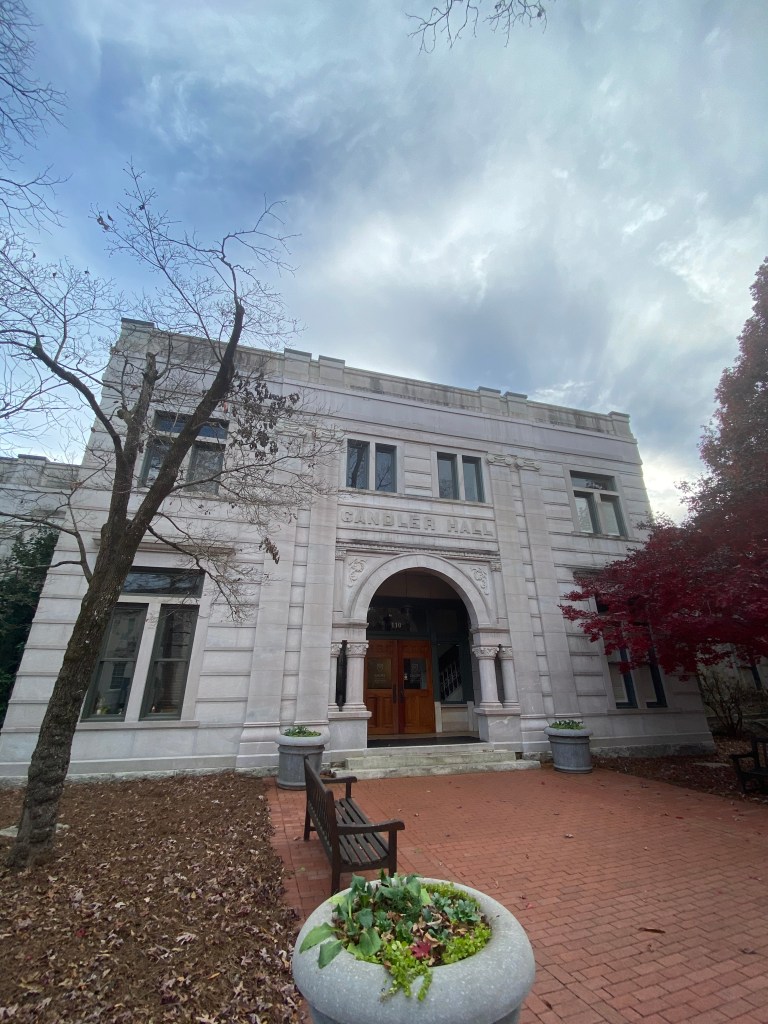
From its beginnings, the exploitation of black bodies has indelibly marked the history of what is now Emory University and its landscape. The University’s most direct precursor was founded in the town of Oxford as Emory College in 1836,[1] a decision influenced by a growing sense of southern identity and the desire to expand the prestige and presence of resources in the South during the nineteenth century.[2] In Emory’s early period, the impact of racism is apparent, for the school itself, the very institution, was built off the backs of exploited people as the buildings on the Oxford campus were constructed by slaves.[3] Racism was institutionalized as well in an educational system that catered to a white male elite.
It is difficult to talk about racism in the context of medical education at Emory because during the time dissection was illegal, Emory College did not have a medical school and though it offered a scientific curriculum for a degree, the standard courses of traditional studies and biblical literature were better favored.[4] Moreover, anatomy was not formally offered until the 1867-1868 school year, and there is not any mention of dissection in the catalogs.[5] In other words, Emory College simply was not the type of school that would have offered dissection before legalization of the practice, and in this manner it is unlikely that explicit cadaver theft would have occurred. In fact, one of the only preserved instances of the practices of anatomy education at Emory College before 1887 is found in the diary of Emory president and physician, Alexander Means, who discusses the material he plans to use for class, a diagram drawing of an eye, not formerly living organic matter.[6] However, this lacuna in archival material does not mean that exploitation of black bodies for the purposes of medical education did not occur at Emory nor that the school is devoid of guilt. Rather, its past is not as clear on these subjects as older schools, such as the Medical College of Georgia.
Although in its early days Emory faculty most likely did not engage in cadaver theft, that does not mean that the faculty members were not connected to the practice or the culture that allowed for such theft to occur. This observation is apparent from the facts surrounding Alexander Means. Means was president of Emory from 1853 to 1855,[7] and he was also a professor at the Medical College of Georgia (MCG) where he held the position of professor of chemistry until 1857.[8] What makes this fact so important is that it ties Emory to the institution of slavery and cadaver theft at MCG. Most significantly, Grandison Harris, the aforementioned-resurrectionist slave purchased in 1852, the year before Dr. Means became president of Emory, was jointly owned by the faculty members of MCG, which included Dr. Means.[9] Means was thus a college president, a professor of chemistry, and a slaveowner. Clearly, he endorsed the actions of cadaver theft via his slave, Grandison Harris.
After the legalization of dissection and cadaver collection in 1887, anatomical education was offered at Emory. For instance, in the 1898-1899 school year, Emory named its first professor of biology, Reverend H. S. Bradley.[10] Part of this newfound support for a science curriculum included the addition of new resources for teaching. The most notable of these additions were the explicit possession of skeletons and the torsos of human bodies for dissection, first advertised in the course catalog of the same year.[11] Before fall 1898, course catalogs did not expressly state if diagrams or actual human remains were studied.[12] These torsos and skeletons are important in the history of exploitation at Emory for it was not necessarily legal for the school to have them. The direct interpretation of the law of 1887 only allowed for medical schools and medical colleges with “professors of anatomy, demonstrators of anatomy, [or] deans of medical and dental schools” to possess cadavers and material for dissection, and Emory at that time had yet to acquire a medical school and lacked even a professor or demonstrator of anatomy among the faculty. The faculty roster at that time listed only a professor of biology.[13] What this means is that the law, strictly interpreted, did not allow for Emory to possess anatomical material. In fact, this interpretation was upheld on September 1, 1924, when Dr. S. Foster, president of the Georgia Anatomical Board, said as much in a letter to Dr. Homer Blinco, secretary for the board.[14] However, what is interesting about the letter is that it concerned a recent enquiry by the Atlanta Casket Company to acquire a body for dissection, a request which Dr. Foster chose to allow as he believed it still served the intention of the law and the advancement of medical understanding.[15] This same ruling was reused by Dr. Blinco later on June 3, 1938 when he agreed to allow a “spare” cadaver to the Warm Springs Foundation due to the spirit of the law.[16] This expansion of the act meant to protect cadavers from exploitation by the white men entrusted to carry it out is probably what occurred two decades prior permitting Emory College, a non-medical institution at that time, to acquire human material for education, a resource the college advertised at least until 1914, the year before Emory established its medical school.[17] In this manner, Emory College’s possession of anatomical material sourced from exploited communities reflects a cavalier subversion of the law meant to prevent such illicit possession.
Emory did not remain a college without a medical school for long.[18] In 1915, Emory acquired the Atlanta School of Medicine, which itself had several precursors, including the Atlanta College of Physicians and Surgeons and the Atlanta Medical College.[19] As the school expanded, moreover, Emory’s history linked to the exploitation of black bodies became more complex. Effectively, the Atlanta School of Medicine and its earlier versions helped to enhance Emory University, and in so doing, a new set of past actions were incorporated into its institutional history including the history of cadaver exploitation. The Atlanta Medical College (AMC) was chartered in 1854 and likely engaged in cadaver theft via resurrectionists. Throughout the 19th century, before the legalization of dissection, the AMC advertised courses in dissection in local papers, enticing students to apply and attend while portraying dissection as the forefront of medical education.[20] One AMC advertisement in The Atlanta Intelligencer dated March 22, 1855, in the pre-Civil War period highlighted their “abundant supply of Material for dissection, [all of which were preserved in wine].”[21] Later, on December 13, 1881, Grandison Harris was caught sending cadavers to Atlanta,[22] and it was common at the time to use liquor to ship illicit material, thus indicating the traffic in human remains to Atlanta.[23] It is likely that the material referenced in the medical school ads were stolen human corpses, most likely black bodies.
Other evidence of the exploitation of black bodies found in the Emory archives includes a photo from the Atlanta Medical College of Dr. Hal Davison’s 1911 class gathered around a deceased black body on a dissection table.[24] It can be viewed via this link: https://album.atlantahistorycenter.com/digital/collection/athpc/id/1125. Seated next to them is a black man, likely the college janitor who cleaned up after dissection classes ended. It was not uncommon in the late nineteenth- and early twentieth centuries for medical students and their teachers to gather around a corpse on a dissection table and be photographed. Some were even printed as postcards. These macabre pictures emphasized the students’ newfound understanding of human anatomy and marked their communal rite of passage as possessors of new knowledge. These class portraits and postcards, moreover, often included black figures, the corpses themselves and frequently black men sometimes labelled janitors who were the very resurrectionists and purveyors of bodies the schools used to secure material for dissection.[25] In the case of the 1911 AMC photograph, there is no information available about the seated black man in the picture that can to be the found in the Hal McCluney Davison papers in the Emory archives or at the Atlanta History Center, where another copy of the photograph is stored.[26] Even so, considering that the practice of grave robbing rarely ended with the 1887 act legalizing dissection and the frequency with which resurrectionists turned medical school janitors were photographed in this way, it is probable that this man in Davison’s photograph was a resurrectionist in the employ of the Atlanta Medical College. In this photograph the legacy of Emory University’s connection to dissection and the cadaver trade is revealed. The picture, moreover, connects the history of Dissection with lynchings, another instance in which white men chose to be photographed with a black body. The words written on the table, “He lived for others; he died for us,” further designated white ownership and exploitation.
Analyzing the history of cadaver exploitation at Emory University is challenging, for unlike at the Medical College of Georgia, there is no definitive document (as least not found by this researcher) like the name of a known resurrectionist on the payroll or other physical evidence such as bone fragments found via forensic archaeology in rooms once used for dissection or body storage. However, there is enough evidence in each era of the school’s early history from 1836 to 1915 and in the precursors to the current Emory Medical School to portray a consistent irreverence for the dead and their post-mortem autonomy, an overwhelming preference for black bodies, and a reflection of the much broader institutionalization of racism in medical education that was prevalent at the time in American society, especially in the South. White medical doctors and their students inhabited a racialized landscape on their campuses, Emory included. To enhance the prestige of their school, the faculty secured bodies for dissection both legally and illegally, and the majority of these bodies were black. To aid the process of body acquisition, the school administrations incorporated black resurrectionists, black janitors, and black undertakers in the pursuit of human remains. The trade in bodies occurred throughout the United States reinforcing dissection as a form of humiliation performed on bodies considered less than human, the racialized end point of human existence for many.[27]
[1] Gary S. Hauk, A Legacy of Heart and Mind: Emory Since 1836. (Atlanta, Georgia: Emory University, 1999), 7.
[2] Henry Bullock, A History of Emory University, (Nashville, Tennessee: Parthenon Press, 1936), 19-21, (accessed July 3, 2022), https://digital.library.emory.edu/catalog/313zs7h4p9-cor.
[3] Mark Auslander, The Accidental Slaveowner: Revisiting the Myth of Race and Finding an American Family (Athens: University of Georgia Press, 2011), 128.
[4] Bullock, History of Emory, 1936, 185-186,
[5] “Catalogue of the Officers, Alumni, and Students of Emory College, Oxford, Georgia, 1867-1868,” Academic catalogs. Emory University Course Catalogs and Bulletins, (Macon, Ga: J.W. Burke & Co., 1867), Stuart A. Rose Manuscript Archives, and Rare Book Library, https://digital.library.emory.edu/purl/4988gthtqt-cor .
[6] Alexander Means, Dairy for 1861, ed, Ross H. Mclean, (Atlanta Georgia: Emory University, 1949). Anatomy was not offered formally until 1867, yet Means talks of teaching it in 1861 although it is not present on the catalogs as a stand alone class, so it was likely taught informally or as part of another class.
[7] Hauk, A Legacy of Heart, 16.
[8] Phinizy Spalding, History of the Medical College of Georgia. (Athens: University of Georgia Press, 1987), 26, 32, 50.
[9] Tarrya Telfair Sharpe, “Grandison Harris: The Medical College of Georgia’s Resurrection Man,” in Bones in the Basement: Postmortem Racism in Nineteenth-Century Medical Training, ed. Robert L. Blakely and. Judith M. Harrington (Washington, D.C.: Smithsonian Institution Press, 1997), 212.
[10]“Catalogue of Emory College, Oxford, Georgia, 1898-1899.” Academic catalogs. Emory University Course Catalogs and Bulletins. Atlanta, Ga.: Foote & Davies Company, 1898. Stuart A. Rose Manuscript, Archives, and Rare Book Library, (accessed June/July, 2022). https://digital.library.emory.edu/purl/320sqv9srk-cor 9; “Catalogue of Emory College for the Year 1896-1897.” Academic catalogs. Emory University Course Catalogs and Bulletins. Atlanta, Ga.: Constitution Job Office, 1896. Stuart A. Rose Manuscript, Archives, and Rare Book Library, (accessed June/July, 2022), https://digital.library.emory.edu/purl/361rfj6qqf-cor, 10.
[11] “Catalogue of Emory College, Oxford, Georgia, 1898-1899.” 24.
[12] “Catalogue of Emory College for the Year 1897-1898.” Academic catalogs. Emory University Course Catalogs and Bulletins. Atlanta, Ga.: Constitution Job Office, 1897. Stuart A. Rose Manuscript, Archives, and Rare Book Library, (accessed June/July, 2022), https://digital.library.emory.edu/purl/52908kpsb8-cor.
[13] “Catalogue of Emory College, Oxford, Georgia, 1898-1899.” 9.
[14] Georgia Anatomical Board, Georgia Anatomical Board Papers,1862-1945, Emory University Historical Collections, Woodruff Health Sciences Center Library, http://pid.emory.edu/ark:/25593/pr7s3, Box 1, Folder, 3, Letter from Dr. S. W. Foster to Dr. Homer Blinco, dated September 1, 1924.
[15] Georgia Anatomical Board Papers, Letter from Foster to Blinco.
[16] Georgia Anatomical Board Papers, Box 1, Folder 6, Letter from Dr. Homer Blinco to Dr. G Lombard Kelly dated June 3, 1938.
[17] “Catalogue of Emory College, Oxford, Georgia, 1913-1914.” Academic catalogs. Emory University Course Catalogs and Bulletins. Atlanta, Ga.: Foote & Davies Company, 1913. Stuart A. Rose Manuscript, Archives, and Rare Book Library, (accessed June/July 2022), https://digital.library.emory.edu/purl/552w3r22vs-cor, 32; Hauk, A Legacy of Heart, 169.
[18] Hauk, A Legacy of Heart, 169.
[19] Bullock, History of Emory, 345-46.
[20] John Harley Warner and James M. Edmonson, Dissection: Photographs of a Rite of Passage in American Medicine: 1880-1930 (New York: Blast Books, 2000), 9; “Atlanta Medical College,” The Atlanta Weekly Examiner, June 3, 1856, Georgia Historical Newspapers, Galileo, Digital Library of Georgia, (accessed May-August, 2022), https://gahistoricnewspapers.galileo.usg.edu/lccn/sn90052349/1856-06-05/ed-1/seq-4/#date1=01%2F01%2F1835&city=Atlanta&date2=12%2F31%2F1920&words=Dissecting+dissections+Medical+medical&searchType=advanced&nottext=&index=10&sequence=0&proxdistance=5&sort=relevance&rows=12&ortext=%22medical+school%22&proxtext=&andtext=dissecting&page=5 ; “Atlanta Medical College,” The Daily Intelligencer, April 23, 1867, Georgia Historical Newspapers, Galileo, Digital Library of Georgia, (accessed May-August, 2022), https://gahistoricnewspapers.galileo.usg.edu/lccn/sn82014304/1867-04-23/ed-1/seq-1/#date1=01%2F01%2F1835&city=Atlanta&date2=12%2F31%2F1920&words=Dissecting+Medic+Medical+MEDICAL+school&searchType=advanced&nottext=&index=0&sequence=0&proxdistance=5&sort=relevance&rows=12&ortext=%22medical+school%22&proxtext=&andtext=dissecting&page=6; “Atlanta Medical College,” The Christian Index, August 28, 1879, p. 3, Georgia Historical Newspapers, Galileo, Digital Library of Georgia, (accessed May-August, 2022), https://gahistoricnewspapers.galileo.usg.edu/lccn/2001233948/1879-08-28/ed-1/seq-3/#date1=01%2F01%2F1835&city=Atlanta&date2=12%2F31%2F1920&words=dissection+Medical+medical+school+SCHOOL+School+Schools+schools&searchType=advanced&nottext=&index=7&sequence=0&proxdistance=5&sort=relevance&rows=12&ortext=%22medical+school%22&proxtext=&andtext=dissecting&page=7 ; “Atlanta Medical College,” The Christian Index, September 7, 1879, p. 3, Georgia Historical Newspapers, Galileo, Georgia Digital Library, (accessed May-August, 2022), https://gahistoricnewspapers.galileo.usg.edu/lccn/2001233948/1876-09-07/ed-1/seq-3/#date1=01%2F01%2F1835&city=Atlanta&date2=12%2F31%2F1920&words=Dissecting+Medical+School+SCHOOL+school+SCHOOLS+schools+Schools&searchType=advanced&nottext=&index=0&sequence=0&proxdistance=5&sort=relevance&rows=12&ortext=%22medical+school%22&proxtext=&andtext=dissecting&page=8 .
[21] “Atlanta Medical College,” The Atlanta Intelligencer, March 22, 1855, Image 3, Georgia Historical Newspapers, Galileo, Georgia Digital Library, (accessed May-August, 2022), https://gahistoricnewspapers.galileo.usg.edu/lccn/sn91099161/1855-03-22/ed-1/seq-3/#date1=01%2F01%2F1835¬text=&date2=12%2F31%2F1920&words=Dissecting+dissection+Medic+Medical+medical+MEDICAL+School+school+SCHOOL&searchType=advanced&sequence=0&index=5&city=Atlanta&proxdistance=5&sort=relevance&rows=12&ortext=%22medical+school%22&proxtext=&andtext=dissecting&=&=&=&=&=&=&=&=&=&=&page=4 .
[22] Daina Ramey Berry, The Price of a Found of Flesh: The Value of the Enslaved from Womb to Grave in the Building of a Nation (Boston: Beacon Press, 2017) , 186.
[23] Sharpe, “Grandison Harris,” in Bones in the Basement, 213.
[24] Hal McCluney Davison Papers, Emory University, Stuart A. Rose Manuscript, Archives, and Rare Book Library, (accessed June/July, 2022), https://findingaids.library.emory.edu/documents/davison527/ , Box 1, Folder 5.
[25] Warner and Edmonson, Dissection 19-21.
[26] “Atlanta Medical College, 1911, Photograph,” Atlanta History Center, Digital Resources of the Kenan Research Center, (accessed June/July, 2022), https://album.atlantahistorycenter.com/digital/collection/athpc/id/11
 Skeletons in the Closet